For emerging writers
Say the story aloud, draw three moments, then write or dictate a sentence for each. Try a shared class plan before independent writing. Choose the level of support by writing experience, rather than age alone.
Free classroom resource
I’ll bring the first line. You decide what happens next.
12 original first lines · Print or project · No sign-up
Where will your story go?
Choose a first line to read aloud, project or write on the board. The question underneath is a helping hand, not a rule. Writers can change the starter to make it their own.
The morning my shadow stayed in bed, I had to go to school without it.
What can a shadow do that its owner cannot?
Someone had left a tiny lighthouse in my lunchbox, and its light was flashing a message.
Who is sending the message, and who needs help?
At closing time, a small fox discovered a blue door behind the library shelves.
What is on the other side? Why does the fox enter?
The new pencil could draw anything except the one thing I needed.
What is missing? How could the character solve the problem?
Our boat was made of paper, but the island ahead was real.
Who is on board, and what could make the journey difficult?
The map showed tomorrow’s weather instead of roads.
Where does the character need to go? How could the map help?
At the bottom of the garden, a dragon was practicing a very small roar.
What is the dragon preparing for? What help does it need?
The train stopped at a station that only appeared when it snowed.
Who gets off, and how will they find their way home?
Every morning, one more chair appeared around our kitchen table.
Who might be coming? What clues could the character find?
“Please return my moon,” said the note tucked under the door.
Who wrote the note, and what do they mean by a moon?
The museum’s oldest dinosaur had muddy footprints.
Where has it been? How will the character discover the truth?
I heard my own voice calling from a shell I had never seen before.
What does the voice say? What choice does the character make?
A place to catch their ideas
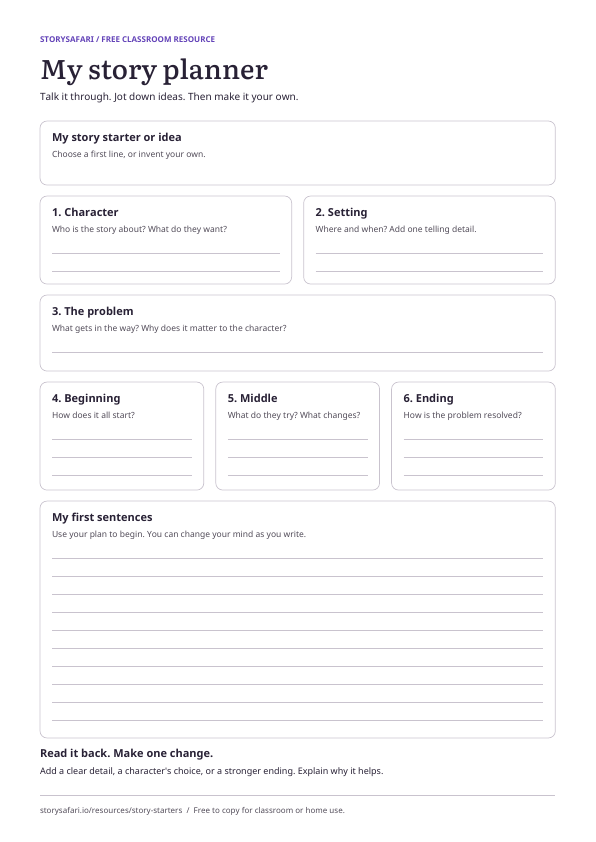
One page to turn “what if?” into a beginning, a middle and an ending. Draw, jot down words, or talk through the boxes with a partner.
One-page PDFs. Free to copy for classroom or home use. Print at actual size on the matching paper, or choose “Fit”.
Make it work for your writers
For a ten-minute warm-up, choose a line, tell a partner what happens next, then write three sentences. For a longer activity, use the planner and leave time to read back and revise.
Say the story aloud, draw three moments, then write or dictate a sentence for each. Try a shared class plan before independent writing. Choose the level of support by writing experience, rather than age alone.
Give the character two possible choices. Add dialogue or a detail that hints at the ending. Ask a partner to explain what they pictured, then revise a sentence to make that picture clearer.
Use across primary and elementary classes, including KS1 and KS2, with the support that fits your students. Year groups and grade levels vary by country.
From words to pictures
Teachers can write an invented example in StorySafari, compare the illustration with the text, and model a revision. The writer’s words stay their own.
The writing activity and planner work entirely on paper. The optional web demonstration includes four illustrated pages free; further illustrations require a purchase or subscription.